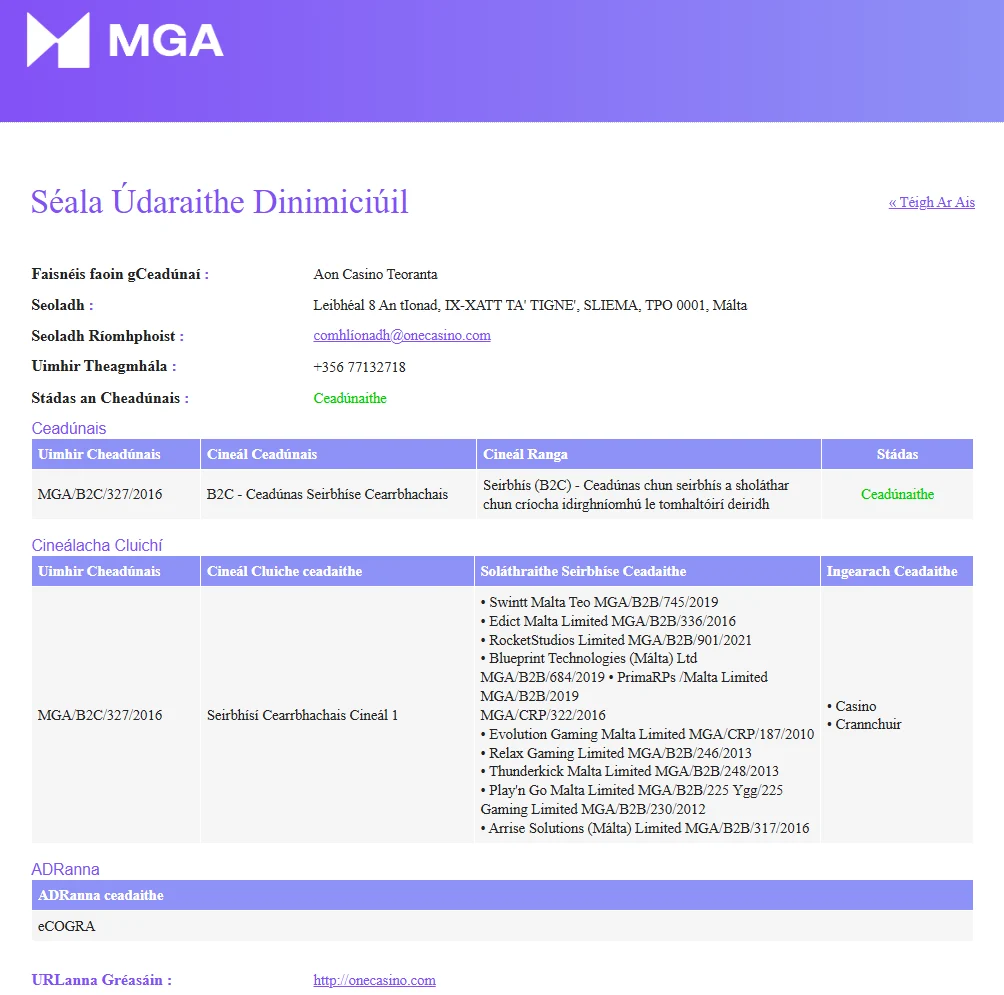
OneCasino account verification in Ireland
 Available in US
OneCasino’s account terms make verification an ongoing process rather than a single sign-up event. Checks can cover identity, address, payment instruments, source of funds or wealth and gaming activity, and they may happen before or after deposits. Additional procedures are stated for deposits exceeding €2,000 and when a withdrawal is requested. The practical consequence is that account setup, funding and cashout are connected: payment ownership, geolocation and the information attached to the account can all affect whether a transaction moves smoothly.

Clár Ábhair
- Geolocation is part of the account-use rules
- Identity checks can extend well beyond a name and date of birth
- Registration and age checks affect access to the welcome flow
- Deposits above €2,000 and withdrawal requests can trigger additional procedures
- Own-name funding is a key link between payments and account checks
- Player limits are easier to tighten than to loosen
- Support channels give the account process a defined contact route
- Questions about OneCasino account verification
- Account consistency matters most when money starts moving
Geolocation is part of the account-use rules
OneCasino’s terms prohibit users from disguising or interfering with their IP address or geolocation. That makes location data part of ordinary account use rather than a detail that only matters during registration. A mismatch between the account context and the apparent location can therefore create friction when the site assesses activity.
For a player, the practical rule is straightforward: use the account from the actual location and avoid tools or settings designed to mask where the connection originates. This is especially relevant when payment activity and account access happen from different devices or networks, because repeated changes can make the activity harder to interpret.
- Keep account details consistent: use the same personal information across identity and payment steps.
- Do not mask location: the terms prohibit disguising or interfering with IP or geolocation.
- Expect location to matter beyond sign-up: checks may happen later in the account lifecycle.
- Separate device convenience from identity consistency: changing devices does not change who owns the account or the payment method.
This rule also intersects with withdrawal readiness. A cashout request can trigger additional checks, so an account that has been used with inconsistent location signals may face more questions at the point when money is being moved out. The withdrawal guide explains the separate deposit, routing and verification steps tied to cashout.
Identity checks can extend well beyond a name and date of birth
OneCasino states that identity and background verification may be requested before or after deposits. The categories it lists include identity, address, payment instruments, source of funds or wealth and gaming activity. Those categories describe the scope of a review, not a fixed checklist of documents that every player will be asked to provide.
That distinction matters. A player should not assume that completing an initial identity step means no further questions can arise later. The terms leave room for additional review as account activity develops, particularly around deposits and withdrawals.
| Trigger or account area | What OneCasino says may be reviewed | Practical consequence |
|---|---|---|
| Account verification | Identity and address | Personal details need to remain consistent across the account |
| Payment review | Payment instruments | The funding method should match the player’s account ownership |
| Financial review | Source of funds or wealth | Higher or unusual financial activity can lead to additional questions |
| Account activity | Gaming activity | Checks can consider how the account has been used, not just registration data |
The safest preparation is not to guess which document might be requested. It is to keep the account information accurate, use payment methods held in the same name and retain ordinary records that explain the source of money used for gambling. That reduces the chance that different parts of the account tell conflicting stories when a review happens.
Registration and age checks affect access to the welcome flow
Gambling is restricted to adults aged 18+ in Ireland. OneCasino also ties its Ireland no-deposit welcome bonus to identity and age confirmation. That creates a practical sequence: the account may be opened first, but the promotional credit is not treated as available until those checks are completed.
Age confirmation is therefore not only a compliance footer message. It has a direct account consequence on the Ireland storefront because the €10 no-deposit bonus is described as being credited after identity and age confirmation. The bonus terms guide covers the separate 45x wagering condition that applies after that credit.
A sensible account setup sequence is:
- Enter personal details accurately and consistently.
- Complete the identity and age steps requested by the site.
- Use payment methods that belong to the account holder.
- Keep the account information current if address or payment details change.
- Treat later checks as part of normal account administration rather than assuming verification ends at registration.
This sequence does not guarantee that no further review will occur. OneCasino’s terms explicitly allow checks at different stages of the relationship, which is why consistency matters more than trying to optimise for a single sign-up checkpoint.
Deposits above €2,000 and withdrawal requests can trigger additional procedures
OneCasino states that additional verification procedures apply when deposits exceed €2,000 or when a withdrawal is requested. It also reserves the ability to carry out checks at other times. The threshold is therefore a clear trigger, not a promise that activity below it will never be reviewed.
Source-of-funds or source-of-wealth review is part of the verification scope listed in the terms. In practice, that means the casino may ask for information that explains how gambling funds were obtained and whether the financial activity makes sense for the account. The terms do not reduce this to a single universal document, so it is better to think in categories rather than inventing a fixed paperwork list.
- Deposit activity develops. The account accumulates a financial history rather than remaining a blank registration profile.
- A stated trigger is reached. Deposits above €2,000 or a withdrawal request can bring additional procedures into play.
- The review can widen. Identity, address, payment instruments, source of funds or wealth and gaming activity may be considered.
- The account information is compared for consistency. Funding ownership and transaction history become operationally important.
The consequence for an Irish player is practical: do not wait until a withdrawal request to discover that the payment method, address or source-of-funds information is difficult to explain. Keeping ordinary records and using your own payment instruments gives the account history a clearer chain from deposit to cashout.
Own-name funding is a key link between payments and account checks
OneCasino states that deposits should be made from an account in the player’s own name. Third-party deposits can lead to a refused withdrawal or account blocking. That makes payment ownership one of the most consequential account rules because it can affect access to money after the deposit has already been made.
The rule is easy to understand through the payment chain. The person registered on the casino account should also be the person who owns the bank, card or wallet account used to fund it. If those identities differ, the casino may need to decide whether the transaction belongs to the registered player and whether the funds can be returned through the normal route.
- Bank account: use an account held in the player’s own name.
- Card: keep cardholder ownership aligned with the casino account.
- E-wallet: use the player’s own wallet rather than another person’s funding source.
- Cashout planning: remember that withdrawals are generally routed back to the relevant deposit method where possible.
The broader payment-method guide covers bank transfer, credit or debit card, paysafecard and Skrill on the Ireland site. For account verification, the central point is ownership: a supported payment method can still create a problem if it belongs to someone else.
Player limits are easier to tighten than to loosen
OneCasino lists deposit, wagering, loss and session limits, along with reality checks, timeout, temporary or permanent self-exclusion and account closure. The most important operational detail is the timing of changes: decreases apply immediately, while increasing or revoking a player-set limit takes effect only after a seven-day cooling-off period.
That asymmetry is useful because it makes a protective decision fast and a risk-increasing decision slow. If a player cuts a deposit or loss limit after noticing that a session is becoming difficult to control, the tighter limit does not have to wait seven days. By contrast, the decision to raise or remove the limit cannot be acted on immediately.
| Control | Function | Timing detail |
|---|---|---|
| Deposit limit | Caps money added to the account | Decreases apply immediately; increases or revocation wait seven days |
| Wagering limit | Caps betting activity over the chosen limit period | Same cooling-off principle for loosening a player-set limit |
| Loss limit | Creates a financial stop point | Tightening takes effect immediately |
| Session limit | Creates a time boundary | Can be paired with reality checks and timeout tools |
| Reality check | Provides a session reminder | OneCasino lists an optional 60-minute interval |
| Timeout or self-exclusion | Creates a stronger break from play | Temporary and permanent self-exclusion options are listed |
The seven-day delay is particularly relevant after a losing session. A request to loosen a limit made in that emotional state does not immediately expand the account’s boundaries. That delay does not remove gambling risk, but it creates time between the impulse to increase exposure and the point when the change can take effect.
Support channels give the account process a defined contact route
OneCasino lists the Ireland support email [email protected] and phone number +356 27782188. The site describes customer support as available 24/7. These channels are the practical route for account-specific questions that cannot be resolved from the general terms.
When contacting support about verification, it helps to frame the issue around the specific stage that is blocked: registration details, an identity request, payment ownership, a withdrawal-triggered check or a limit setting. That makes the question easier to answer than a broad request to “verify the account” without identifying where the process has stopped.
For a dispute or a question about the legal framework rather than routine account administration, use the licence and Ireland status page as the navigation point. The account page stays focused on the operational checks and controls attached to ordinary account use.
Responsible-gambling support is separate from customer service. If gambling is causing harm or financial pressure, support in Ireland is available through problemgambling.ie and the Gambling Care helpline on 1800 936 725. These services are designed around gambling harm rather than transaction troubleshooting.
Questions about OneCasino account verification
Can OneCasino ask for verification after a deposit?
Yes. OneCasino’s terms say identity and background checks may be requested before or after deposits and can cover identity, address, payment instruments, source of funds or wealth and gaming activity.
When can additional OneCasino checks apply?
The terms state that additional procedures apply for deposits exceeding €2,000 or when a withdrawal is requested, and checks may also occur at other times.
Can I fund a OneCasino account from someone else’s payment account?
OneCasino states that deposits should come from an account in the player’s own name. Third-party funding can lead to a refused withdrawal or account blocking.
How quickly do OneCasino player-limit changes take effect?
Decreases to player-set limits apply immediately. Increasing or revoking a limit takes effect after a seven-day cooling-off period under OneCasino’s terms.
Account consistency matters most when money starts moving
OneCasino’s account rules connect identity, location and payment ownership to the transaction history of the account. Checks may happen before or after deposits, deposits above €2,000 and withdrawal requests can trigger additional procedures, and third-party funding can create serious cashout friction. The strongest preparation is simple: keep personal details accurate, use payment methods in your own name, do not mask geolocation and treat source-of-funds questions as part of the account lifecycle rather than an exceptional event. Player limits add a separate safety layer, with immediate tightening and a seven-day delay before a limit can be loosened. Gambling can cause financial loss; use those controls early rather than waiting for a difficult session to force the decision.
Read next
- Payment methods and money flow
- Withdrawal rules and readiness
- Licence and Ireland status
- OneCasino Ireland overview
Ullmhaithe ag eagarthóirí «Onecasino-ireland.org».